Comparison
The Tidio alternative
that keeps questions off your plate.
Your day gets eaten by the same questions. Not hard ones, just the constant drip of "where is this," "what's the policy," "can you resend that link," over and over.
Here's the promise: about half your conversations stop needing anyone, and you can watch it happen on your own traffic. We measured 50.4% solved without a human on our own support. When it's not solved, it hands off with the whole transcript. And if you want the fastest proof, email support@outlearn.com right now, the reply you get is the product.
Lyro's bet is that a normalized Q&A stays current. Somebody has to keep it current. That works until your source of truth changes faster than your team can rewrite and reformat it, then the bot drifts and you're back in the queue. That's usually when teams start hunting for a Tidio alternative. Outlearn learns from the originals instead, so there's nothing extra to maintain.
Updated
- Who does the answering
- Half your volume, handled
- No second copy of your knowledge
- 20 systems, read where they live
- Knows who is asking
- One agent, the right answer per customer
- Live proof
- Email support@outlearn.com
Not just replies. Resolutions. Outlearn solves 50.4% of conversations without a person, measured on our own support. When it can't, it hands off with the whole transcript so your team never starts cold.
It reads 20 systems directly and keeps them current without anyone maintaining a Q&A library. Connect your docs where they already live, and the agent answers from that reality, not a copied dataset.
Yes, by identity. Outlearn scopes retrieval to who is asking, so a trial user and an employee can ask the same question and get two different correct answers, pulled from the right set of sources.
Email support@outlearn.com right now. The speed and clarity of the reply is the product.
Less waiting. Fewer repeat answers. Customers get the answer right away, and your team gets the exceptions with full context so they can finish the job fast. Outlearn is an AI support agent that connects to whatever systems you already run and answers from them directly, without turning your docs into a separate thing to maintain.
Tidio is a live chat and helpdesk built for small ecommerce teams, and Lyro is its AI agent. You get live chat with customers, tickets in one place, and an AI that answers from a normalized Q&A copy of your content, metered per conversation.
Maintenance is the hinge. Lyro answers from a normalized Q&A copy somebody on your team keeps current, and it stays good as long as that copy stays good. Outlearn answers from the originals, so there isn't a second knowledge base to babysit. Pick the Tidio alternative based on whose week gets lighter, the people helping customers or the people maintaining the bot.
Short answer
Yes, for scattered knowledge. Outlearn is the Tidio alternative that reads answers directly from the systems you already run, instead of asking you to rebuild them as Q&A pairs. You connect sources in one line of code, it re-reads regularly, and it hands off with the full transcript when a human should take it. At 1,000 AI resolutions a month that's $199 all in. The same workload on Tidio works out to roughly $1,419 at their own published $0.70 floor.
No, for one tidy FAQ with short threads. If everything you know fits in a single clean help center and your conversations run short, Tidio will do the job for less. Their free tier gives you 50 Lyro conversations, so you can see your real numbers before you switch anything.
- 50.4%
- Conversations Outlearn solves without a human
- 20
- Systems Outlearn reads where they live
- 1
- Line of code to put it on your site
- 60 sec
- Typical wait when you email it a question
Outlearn vs Tidio at a glance
| Capability | ||
|---|---|---|
| Live chat widget | yes, one line of code | Yes |
| What it costs | ||
| What the meter counts | an AI reply | a thread an AI replied in |
| Replies inside one thread billed separately | yes, each reply | no, one charge |
| Charges again if the customer returns later | No | yes, after 15 minutes |
| Free tier | 100 credits a month | 50 Lyro conversations, once |
| Cost per resolved conversation | $0.20 | $1.42 |
| What the AI reads, and who sees it | ||
| Third-party knowledge systems the AI reads | 20 | Zendesk public articles |
| Knowledge is stored as | the original, read in place | Q&A pairs generated from it |
| Answers scoped to each end user's permissions | on your knowledge base | not published |
| Site crawl page limit | no published cap | 60 pages, 500 URLs total |
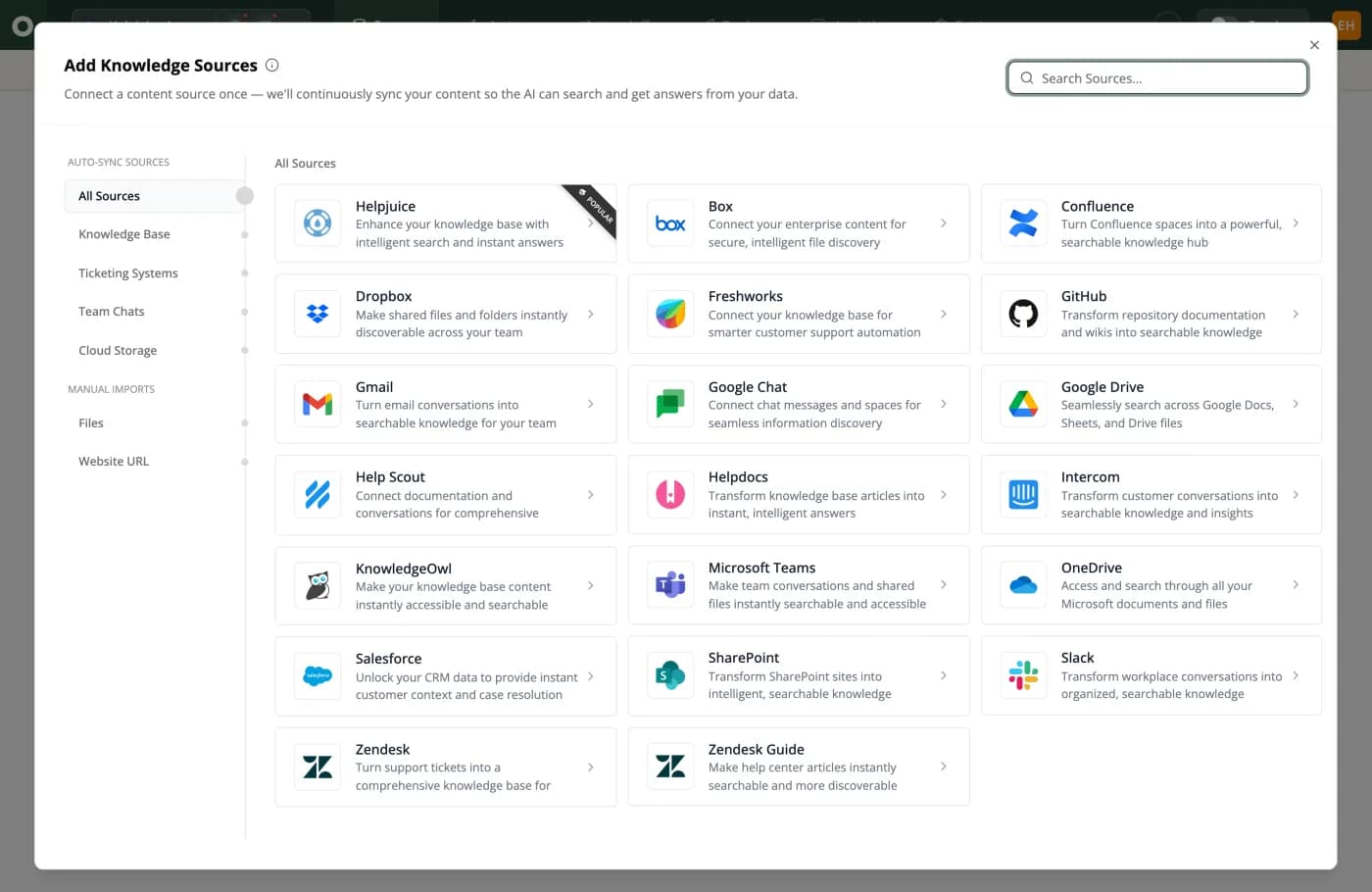
This is a screenshot of Outlearn's knowledge connectors. Connect once, and it keeps re-reading the original sources for you, so nobody maintains a separate copy just to keep the agent accurate.
Where Outlearn and Tidio actually differ
01
Your knowledge stays current without a babysitter
A customer asks about today's policy, and the bot replies with last quarter's version. Not because anyone was careless, because the doc changed and the bot's copy didn't. With Outlearn, there's no separate copy to go stale. It re-reads connected sources every 30 minutes, and nothing gets turned into normalized Q&A pairs your team has to babysit.
Someone changes a policy, updates a doc, or fixes a process, and Outlearn just starts using it. No reformatting, no re-uploading, no knowledge-duty rotation to keep a parallel Q&A set fresh. That ongoing babysitting is exactly the job a Tidio alternative is supposed to delete, because your team already did the work once when they wrote the original.
A customer asks a question, and Outlearn pulls from the systems you've connected, scoped to who's asking. An anonymous visitor gets public docs. A paying customer gets the articles for their plan. An employee gets internal runbooks. That's the kind of scoping you want from a Tidio alternative when access actually matters. Every answer ships with a sources chip, so your team can open the exact pages it used.
One limit you'll notice in week two. Per-person scoping works where Outlearn can read the source's user model, which today means knowledge-base sources. Cloud-file connectors don't import users, so an answer pulled from a cloud drive isn't scoped per person. If you need strict per-person visibility, keep that boundary in mind when you connect sources.
The screenshot shows an Outlearn reply with the exact articles it used attached. That's what you buy with a Tidio alternative like this: every answer comes with its receipt, so your team can open the sources behind it and trust what the customer saw.
02
Lyro's knowledge model is built on copies
Somebody on your team ends up rewriting your knowledge into the bot's format, then doing it again the next time anything changes. It's real work, and no dashboard shows it. Lyro's design is that everything it learns becomes normalized Q&A pairs, a fine fit for FAQ-shaped content, and the limits below follow from that choice.
On help.tidio.com, checked 7 August 2026, Lyro's published sources include things like a site crawl, uploaded files, hand-written Q&A, plus Zendesk public articles and solved chats. Notion, Drive, Confluence, and SharePoint aren't on that list, which is an absence in their docs rather than a confirmed limit. Still, it's the kind of gap you check when you're evaluating a Tidio alternative.
Their own help center, checked 7 August 2026, says: 'when you re-synchronize, Lyro basically removes the associated Q&A pairs and replaces them with new ones... your manual edits will be gone.' Automatic weekly re-sync is Plus and Premium only. So if you hand-tune answers, you have to plan for that refresh behavior, and for who owns the cleanup when the source changes.
The crawl caps are concrete: the priority scan is capped at 'up to 60 pages', and it's 'up to 500 URLs overall'. That's fine for a small, tidy help center. It gets tight fast when your real answers live across a lot of product, policy, and troubleshooting pages.
Tickets are also explicit. In their help center doc, checked 7 August 2026, they say: 'tickets (emails handled in the panel) are not scanned by Lyro for knowledge this way.' And Lyro Connect is where Lyro replies, like Zendesk and Salesforce, not what it reads. That distinction matters, and we keep it clean too.
03
The agent belongs where the questions are
Someone drops a routine question in a team channel, and it just sits there for an hour. Not because it's hard, because no support widget lives where the question showed up. Those questions can get answered on the spot. This Tidio alternative can show up where people ask: web chat, email, Slack, Teams, and Google Chat, whatever you use. A lot of knowledge questions come from inside the company.
It also does work mid-conversation. Outlearn can take actions in Salesforce and Stripe, and it can hit a custom HTTP endpoint you own. So instead of telling someone where to click, it can look something up, change something, and come back with the result.
When it needs a person, the handoff isn't a dead end. Outlearn passes the whole transcript into Zendesk, Intercom, LiveChat, Slack, and four others, so your teammate opens it knowing what was asked, what was answered, and which sources were used.
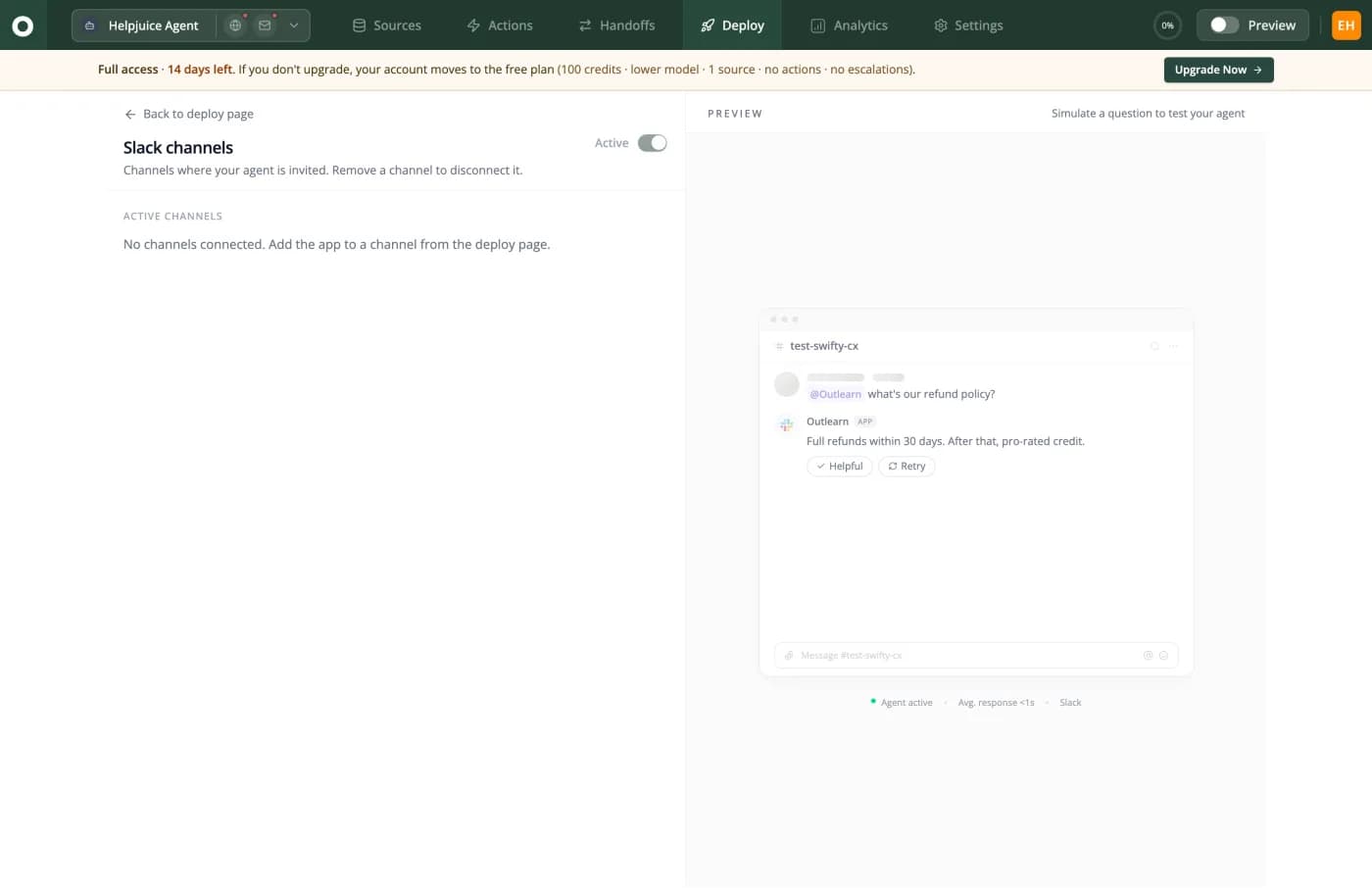
This is a screenshot of Outlearn answering a refund policy question in Slack. The questions that never reach a widget still get answered where they're asked, with a quick way to confirm it helped or retry.
04
You're not buying a shift anymore
You're paying for an AI answer that didn't help, then replying yourself anyway. Lyro's meter starts on a reply, not a resolution, so a correct answer, a partial answer, and an "I don't know" all count the same. Outlearn bills per AI reply too. Nobody in this category charges on outcome, and anyone claiming their AI support tool is free when it fails is describing a rounding error you haven't found yet.
The honest way to read Lyro pricing is the shift metaphor. It's priced like a person covering a shift, because it was designed as a stand-in for a person taking one.
The ladder: $0.70 to $0.78 self-serve depending on volume, and $39 a month buys 50 conversations, while 1,000 is $700, on tidio.com/pricing, read 7 August 2026. Above 1,000 there is no published price at all. The $0.50 number you might see elsewhere is gated to Plus and Premium through a sales call. If you're comparing a Tidio alternative, make sure you're comparing the plan you can actually buy. If ManyChat is on the same shortlist, the ManyChat comparison covers it too.
There's no overage. At 95% of quota they auto-upgrade your plan, with a notification at 80%. The response to heavy usage is a bigger plan, automatically. It's a price list for a world where support capacity is counted in shifts, and the question is whether you are still buying shifts.
05
Tidio wins on long threads
One place, and we'd rather you hear it from us. On a single Tidio conversation, Lyro can answer a dozen times and it bills once. Outlearn bills per reply, so on a conversation that takes six exchanges, we cost more per thread. Tidio also says, 'Responses from Flows and Lyro AI Agent are not counted as "agent replies",' so one thread can't hit two meters.
At 1,000 resolutions a month the pricing table below has Tidio at roughly seven times our bill, per-thread billing included. Their advantage holds only while your threads stay long and your volume stays under their published ladder. Their free tier gives you 50 Lyro conversations to measure your real thread lengths before believing either of us.
The thread count flips the bill
The one variable that flips the bill is how many separate threads your AI speaks in. Tidio's cost is a plan plus a Lyro package, Outlearn's is credits. Model any Tidio alternative on your own thread count before you trust its math. The table shows one modeled scenario, and the calculator below takes your real volume, so nobody has to guess.
| Line | Tidio | |
|---|---|---|
| Plan | Growth, $199 | Starter, $29 |
| AI package needed | included | beyond the published 1,000 ladder |
| Billable AI units | 4,000 credits | ~1,985 Lyro conversations |
| Unit price | $0.0399 per credit | $0.70 at their floor |
| AI cost | included in Growth | ~$1,390 |
| Total per month | $199 | ~$1,419 |
| Charged when the AI misses | Yes | yes, unless it hands off instantly |
How we calculated this
Tidio publishes its Lyro ladder up to 1,000 conversations a month and gates anything above that to Premium with no public price, so the figure here extrapolates at their own published floor of $0.70 and is an estimate rather than a quote. Reaching 1,000 resolutions means Lyro replying in roughly 1,985 threads at our measured 50.4% self-solve rate, because their meter counts replies rather than resolutions. The 15-minute thread reset would push that number higher and isn't modeled. Outlearn is shown on Growth at four AI responses per resolution at one credit each, which is our assumption rather than measured data. Run the same math on any Tidio alternative before you buy.
Tidio pricing verified 7 August 2026 against their own pricing page.
Cost calculator
Credits, tickets and resolutions are not the same unit, which is why comparing these two means building a spreadsheet. Put your numbers in instead.
Outlearn
Growth · 4,000 credits
$199/mo
$0.20 per resolution
Tidio Lyro
Premium, sales-quoted · 1,985 Lyro conversations
$1,419/mo
$1.42 per resolution
That is $1,220 less than Tidio Lyro a month, because their Lyro meter fires on the first reply, not on a resolution, so a conversation their AI cannot answer still costs a unit unless it hands off immediately.
Outlearn bills one credit per AI reply, so your 1,000 resolutions at 4 replies each is 4,000 credits. Tidio Lyro bills every conversation its AI touches rather than every one it resolves, so their figure divides your resolutions by a 50% self-solve rate, the average across Outlearn agents with at least 30 conversations, to get the units they would charge for. Above 1,000 Tidio publishes no price; shown at their $0.70 floor. Tidio Lyro prices checked 7 August 2026, ours 7 August 2026.
Read the scores yourself
We couldn't reach G2 or Capterra from here, so those rows are empty rather than filled with numbers we didn't verify.
| Product | G2 | Capterra | Trustpilot |
|---|---|---|---|
| OutlearnNew product. No third-party listing yet. | No listing | No listing | No listing |
| HelpjuiceOur parent company, in business since 2011 | No listing | 4.7104 reviews | No listing |
| TidioAlso 4.7 from 590 on Software Advice and 9.3/10 on TrustRadius | No listing | No listing | 3.8223 reviews |
How we picked these
Tidio holds 3.8 from 223 on Trustpilot and 4.7 from 590 on Software Advice. That spread is normal for a product with a big free tier, where the unhappy are more motivated to post. We won't build an argument on the lower number. The case for a Tidio alternative is about what the agent can read, not review scores.
Test a Tidio alternative on real traffic
- 1
Add it without changing anything
Drop one line of code on your site, or skip the site entirely and just email it a question. Nothing about your current setup moves, changes, or gets replaced. Tidio keeps doing whatever it's doing while you watch what stops needing a person.
- 2
Connect your existing sources
Hook up the places your answers already live, whatever those are, from the 20 systems Outlearn reads. Nothing gets rewritten into Q&A pairs, and there's no copy to lose on a re-sync. You keep ownership, the agent just reads.
- 3
Crawl your docs site
Point it at your whole docs site. There are no published page or URL caps on our crawl, and it keeps re-reading so the agent doesn't drift as pages change. The goal is boring consistency, even after your next update.
- 4
Turn it on, then measure
Enable it where questions actually show up, chat, email, or the team channels it supports, then measure what stops needing a person. That measurement, on your own traffic, is how a Tidio alternative should earn the switch.
Frequently asked questions
What is the best Tidio alternative in 2026?
It depends on sprawl.
If your truth is spread across Confluence, SharePoint, Drive, or a helpdesk knowledge base, none of those are on Lyro's published source list. That's the gap Outlearn fills: 20 systems read directly, with no Q&A pairs to maintain. If everything you know fits in one tidy FAQ and your threads run short, Tidio will cover it for less.
Does Tidio charge you when Lyro cannot answer?
Yes, except for instant handoff.
Tidio's meter starts on a reply, so a reply that says it doesn't know is still a billed conversation. The one free path is narrow: their help center, checked 7 August 2026, says 'nothing will be deducted from your Lyro quota if Lyro immediately performs handoff.' Their Suggestions panel shows the questions Lyro failed to answer, and each of those was still a billed conversation.
How much does Tidio Lyro cost per conversation?
$0.70 to $0.78.
That's the self-serve Lyro rate per conversation depending on volume. $39 a month buys 50 conversations, and 1,000 is $700. The $0.50 rate you may see quoted elsewhere isn't a price you can buy self-serve, it's gated to Plus and Premium via sales. Above 1,000 a month, there's no published price at all.
Does a returning customer count as a new Tidio Lyro conversation?
Their docs disagree.
The help center, updated 17 June 2026, says a thread closes after 15 minutes of inactivity, any new message starts a brand new thread, and Lyro's new response will be counted against your quota once more. Their pricing FAQ says the opposite, that a returning customer still counts as a single conversation. We believe the help center because it's newer and operational, but ask them before modeling costs on either.
Can Tidio's Lyro read Confluence, Notion or Google Drive?
Not on the published list.
Tidio documents Lyro learning from a website crawl, CSV, PDF, manual Q&A pairs, Zendesk public help center articles, and solved live chats. Confluence, Notion, and Google Drive don't appear there, which is undocumented rather than impossible. Also watch the Lyro Connect wording: it's where Lyro replies, not what it reads. The Tidio alternative question comes down to sources. Outlearn reads all three directly.
Is Tidio cheaper than Outlearn?
At low volume, yes.
At volume it flips: 1,000 AI resolutions a month runs about $199 on Outlearn's Growth plan, while the same workload on Tidio works out to roughly $1,419 at their published $0.70 floor. Their meter counts every thread Lyro replies in, and their ladder stops at 1,000. Conversation shape matters too: they meter once per thread, we meter per reply, so short threads favor them and long back-and-forth favors us. Use the calculator on this page to see which one you are.
Can Outlearn and Tidio run at the same time?
Yes, without changing anything.
Outlearn plugs into whatever you already run, and Tidio can be part of that, but it's not required for the test. The practical reason to run both is simple: Lyro bills the moment it replies once, so anything the Tidio alternative answers first is a Lyro conversation you never pay for. Nothing migrates. Give it an afternoon, then email support@outlearn.com and the reply you get is the product.
Connect your sources, cut volume
Connect the systems your answers actually live in, then watch how many questions stop needing a person. The free tier is 100 credits a month, no card, and you can sanity-check the experience by emailing support@outlearn.com. That's the whole test of a Tidio alternative.
Sources checked 16 August 2026: The Lyro AI agent limit · Lyro data sources · Outlearn pricing.
Switching from something else?
Switch from Freshdesk
A mature, cheap helpdesk priced per agent, with SSO on its entry plan. Outlearn charges nothing per seat.
Switch from Zendesk
A fair AI meter, exports switched off until you ask, and a bill that counts agents. Outlearn reads your Guide in place.
Switch from ManyChat
ManyChat bills every person you can reach, because Instagram marketing is the job. Outlearn bills the answers it writes.
See every tool
Every platform we have compared Outlearn against, side by side.