Ranked roundup

AI chatbot pricing,
from the vendor that ranked itself fourth.

Every roundup for this query is written by somebody selling one of the products, including this one. Two of the three vendor-owned pages currently ranking put themselves first. One of those ranks itself number one in a section headed "6 Best" under a headline that says thirteen, with no disclosure anywhere on the page.

So here is ours, with the thumb taken off the scale. Twelve products, six axes, one rubric published in full, and every price read off the vendor's own page on the date shown. Outlearn is one of the twelve.

We came fourth. The two things that cost us the points are printed in our own entry, and one of them is that our marketing site claims a feature we do not have.

Updated

Top three, on the rubric below

  1. Help Scout23/30

    Teams who want the AI meter to be on their side

  2. Intercom Fin23/30

    Teams already on Intercom, and anyone who wants outcome pricing

  3. Chatbase22/30

    Anyone whose first question is what this costs

Where we came

Outlearn21/30

A zero on the one axis we refuse to self-grade, and we bill replies that miss. Both cost us points and both are printed in the table.

Short answer

The best AI chatbot for customer service depends on which kind of failure you can least afford. If it is the bill behaving badly, buy Help Scout: it is the only vendor here that publishes, in its own words, that a conversation the customer escalates is not charged. If it is the price itself, Chatbase costs twelve cents per resolved conversation, eight times less than the median. If it is answers quietly going stale because your documentation lives in five different systems, that is the problem we built Outlearn for, and we still came fourth.

The numbers nobody publishes. Costed at the same 1,000 resolved conversations a month, this field runs from $0.12 to $1.98 per resolved conversation, a sixteen-fold spread. Five of the twelve publish nothing at all about what their AI does when it cannot answer. One publishes the pricing philosophy and withholds the rate.

12
Products scored on one published rubric
4th
Where Outlearn came on its own list
16x
Spread in cost per resolved conversation
5 of 12
Publish nothing about AI handoff

The whole field on one screen

Twelve products in rubric order. Hover any vendor name for the page each figure came from and the date we read it. Nothing in this table was taken from another roundup.

Prices are the cheapest plan that carries an AI agent, at the billing basis each vendor publishes as its default. Where a vendor does not publish something, the cell says so.
ProductStarting priceAI meterSAML / SSOTrial
Help Scout$25 per user/mo on Standard, annual billing. Free plan for up to 5 users.$0.75 per resolution, and only per resolutionYes, as a paid add-on on Plus and Pro15-day trial, no card. Plus three months of unlimited AI Answers resolutions free.
Intercom Fin$29 per seat/mo on Essential, plus Fin usage on topFrom $0.99 per Fin outcomeYes, on Expert at $132 per seat14-day trial, no card, and their page says it includes Fin and the add-ons
Chatbase$32/mo on Hobby. Free plan with 50 message credits a month.Message credits, spent per AI reply, no rolloverYes, on Enterprise only7-day trial on Hobby, Standard and Pro. Free plan with 50 credits a month.
Outlearn$99/mo on Starter. Free plan with 100 credits a month, free forever.Credits, spent per AI reply, including the replies that missnot self-scored; ask us in writingFree tier, no card, plus a 14-day trial on the paid plans
Front$25 per seat/mo on Starter, capped at 10 seatsAutopilot from $0.05 per conversation, not per resolutionYes, SSO and SCIM on Professional at $65 per seat14-day trial with all Professional features
ChatBot.com by LiveChat$19 per user/mo on Essential at annual billing, or $25 monthlyPer AI resolution, with an exclusion list published in their docsYes, custom SSO on Enterprise only, via SAML 2.014-day trial, no card required
Crisp$45/mo on Mini, per workspace, not per seat. Free plan forever.Bundled AI credits stated in dollars, translated to an approximate conversation countNot published on their pricing page14 days of full access on any plan, plus a free plan with no AI credits
Zoho Desk$7 per user/mo on Express, billed annually. Free plan for three users.LLM tokens, with up to 30 million free per monthNot published on their pricing page15-day trial of any plan, no card. Free forever plan for three users.
Zendesk AI agents$55 per agent/mo on Suite Team, paid yearlyPer automated resolution. The rate is not published.Not stated on their pricing page14-day trial
Tidio Lyro$24.17/mo on Starter at annual billing, 10 seats included. Free plan available.Per Lyro conversation, triggered by at least one AI replyYes, on Premium only, which is contact-for-pricing7-day trial of all features and plans, no card. Free plan with 50 conversations a month.
GorgiasHelpdesk from $50/mo with the AI Agent bundled into the card priceTwo meters. A ticket fee, plus an automation fee when the AI resolves without a human.Not published on their pricing pageFree signup. Their pricing page does not state a trial length.
Helply$1 per ticket. No seat fees. Minimum 250 tickets a month.Per ticket that reaches it, not per ticket it resolvesNot published on their pricing pageNot stated on their pricing page

How we decided what the best AI chatbot for customer service is

Six axes, scored 0 to 5, 30 points available. The order on this page is the sum, sorted, with a tie-break published below. It is arithmetic rather than editorial preference, which is the only reason a ranking written by a competitor is worth reading at all.

The axes are not the ones a feature grid would pick. Nobody buys customer service chatbot software for the number of channels it supports and then regrets the channels. They regret the meter, the stale answers, and the conversations that went nowhere. So those are what we scored.

Handoff
When the AI cannot answer, does the conversation reach a human with the transcript attached, is the mechanism documented, and does the meter punish it?
Meter honesty
Are you charged for an answer that did not work?
Knowledge freshness
Does it read your live systems, or a copy you uploaded that stops matching reality the moment somebody edits the original?
Price transparency
Can you work out your own bill from the public pricing page without talking to sales?
Cost at 1,000 resolutions
What does one resolved conversation cost in the scenario above?
Published SSO
Is SAML or SSO published, and on which plan?

The scenario every cost figure uses

1,000 resolved conversations a month, 10 agents, 4 AI replies per resolved conversation, and a 50% auto-solve rate, so 1,984 conversations reach the AI.

One scenario, applied to all twelve, with the arithmetic printed on every row so you can redo it at your own volume. The auto-solve rate is Outlearn’s own measured figure rather than an industry number, and using our rate on everyone else is an assumption rather than a measurement. It is the same assumption for all twelve, which is what makes the column comparable even where it is not exact.

The tie-break, written down

Total first. Then handoff, then meter honesty, then cost. A tie-break nobody can see is exactly where a ranking gets quietly rigged, and ours is load-bearing twice: it puts Help Scout above Intercom on 23 points each, and it puts Outlearn above Front on 21 each.

What is wrong with this rubric

  • It scores the AI layer and the buying experience, not helpdesk breadth. Zendesk's integration catalogue and Gorgias's commerce actions are real advantages that this rubric cannot see, which is why both sit lower than their product quality deserves. Read their entries, not their positions.
  • Handoff is the first axis and the tie-break, and handoff is the axis Outlearn scores best on. That is a bias and we would rather name it than have you find it. We chose it because it is the thing that breaks in production and because not one of the four roundups currently ranking for this query has a column, a heading or a rubric line for it. The tie-break is also what puts us above Front on 21 points each. Add up the other five columns yourself, they are all in the table.
  • Cost is one scenario, not a law. At 100 resolved conversations a month the seat-priced vendors look far worse and the flat-rate ones look far better. At 10,000 the credit meters get expensive and Crisp's flat workspace price wins outright. The arithmetic is on every row so you can redo it at your volume.
  • Nothing here is a hands-on test of answer quality. This is a rubric over published facts and our own product knowledge, not a lab. Anyone claiming to have measured answer quality across twelve vendors in one article has not.
  • We hold no third-party ratings for these products, so there are none on this page. The scores are ours, they are labelled as ours, and there is no AggregateRating in the markup pretending strangers agreed with us.

What we did not do

  • No vendor paid to be here, and there is no affiliate link, tracking parameter or referral code anywhere on this page. You can read the source of every link.
  • No vendor saw this page before it went live, and none was asked to comment. If a vendor tells us a fact is wrong we will fix it and move the date at the top.
  • No vendor was left out for being better than us. The twelve are the twelve we could verify from public pages, and sixteen more are named further down as untested rather than quietly omitted.
  • Nothing was ranked on a number we could not source. Zendesk's cost row is empty because they do not publish a per-resolution rate, and an empty cell is more honest than a guess dressed as research.
Every score for every vendor, including ours. Twelve rows, six axes, no vendor left unrated. Axis order left to right: Handoff, Meter, Knowledge, Transparency, Cost, SSO.
ProductTotalHandoffMeterKnowledgeTransparencyCostSSO
Help Scout23/30453533
Intercom Fin23/30444524
Chatbase22/30522553
Outlearn21/3052554not self-scored
Front21/30233445
ChatBot.com by LiveChat18/30442422
Crisp18/30233451
Zoho Desk17/30242351
Zendesk AI agents15/30344112
Tidio Lyro15/30323412
Gorgias13/30323311
Helply12/30213411
Look at the length of the list
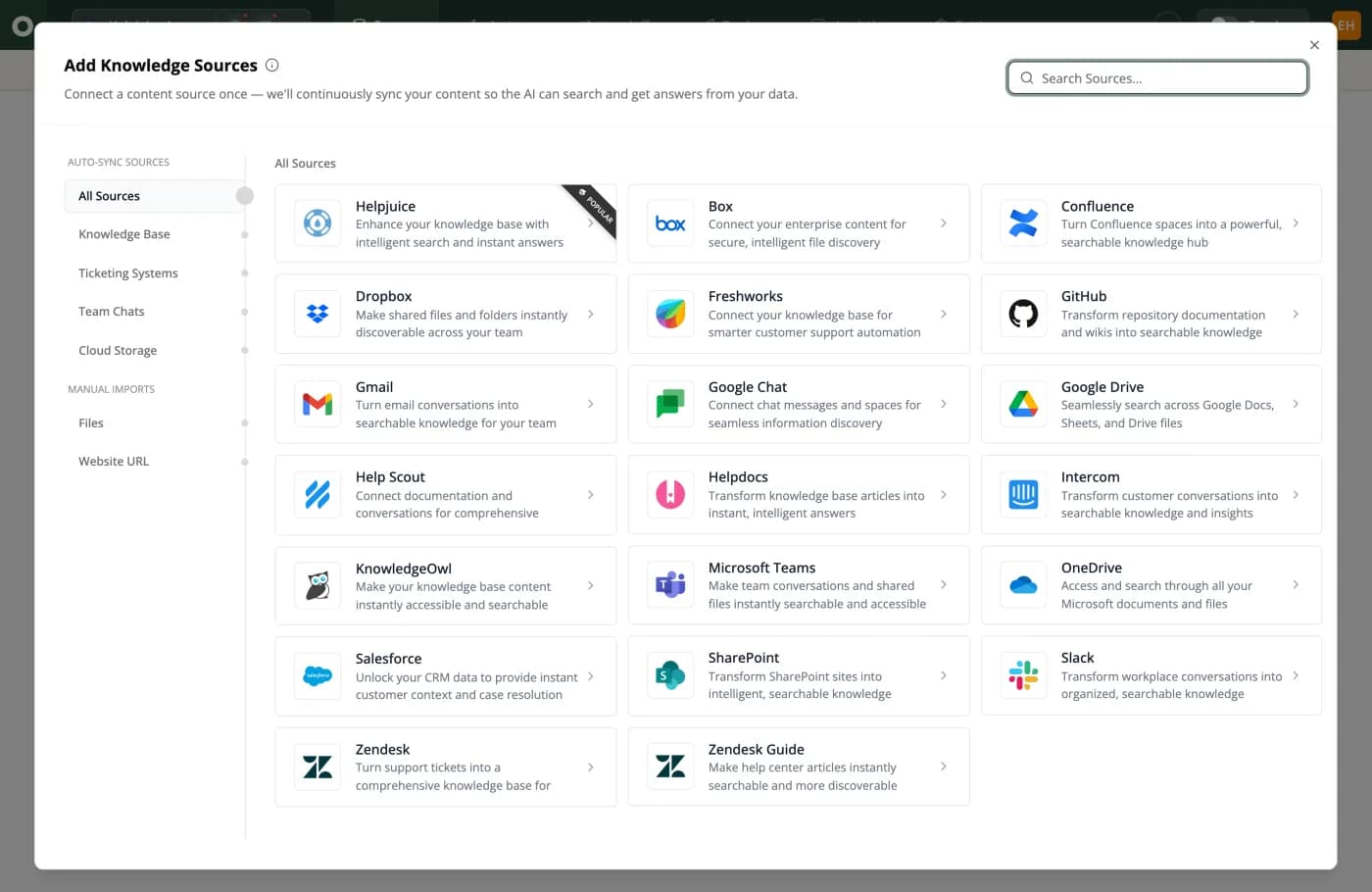
Outlearn knowledge connector catalogue showing rows for Confluence, SharePoint, Google Drive, OneDrive, Box, Dropbox, GitHub and a website crawl, each available as a live source the agent re-reads on a schedule

The knowledge axis, made concrete. This is the list every score in that column was measured against: how many systems a vendor's agent can read without you copying a document into it first. Four of the twelve read nothing but their own help centre and whatever you upload.

Cost per resolved conversation, normalised

This is the column the rest of the internet does not publish. Vendors quote credits, tickets, seats, resolutions, outcomes, conversations and tokens, and those units are not comparable, which is doing work for them rather than for you. So here is one unit for all twelve: what one resolved conversation costs, at the scenario above, with the arithmetic on every row.

Hover a product name for the workings. 1,000 resolved conversations a month, 10 agents, 4 AI replies per resolved conversation, and a 50% auto-solve rate, so 1,984 conversations reach the AI. Zendesk's AI column is empty because they publish the philosophy and not the rate.
ProductSeatsAITotal per monthPer resolved conversation
Help Scout$250$750$1,000$1.00
Intercom Fin$290$990$1,280$1.28
Chatbasenone$120$120$0.12
Outlearnnone$199$199$0.20
Front$250$99$349$0.35
ChatBot.com by LiveChat$79$792$871$0.87
Crispnone$330.50$330.50$0.33
Zoho Desk$230$0$230$0.23
Zendesk AI agents$550not publishednot computablenot computable
Tidio Lyro$24.17$1,388.80$1,412.97$1.41
Gorgiasnone$1,686$1,686$1.69
Helplynone$1,984$1,984$1.98

Two figures in that table are extrapolations rather than quotes and both say so on hover. Tidio’s published ladder stops at 1,000 conversations, so the row above that uses their own floor rate. Gorgias’s tier prices carry our 7 August check, because their plan cards did not render into the served HTML when we looked again on 9 August.

Handoff, which nobody else scores

Not one of the four roundups currently ranking for this query has a column, a heading or a rubric line for what happens when the AI cannot answer. It is the thing that actually breaks in production. A bot that answers 60% of your volume well and abandons the other 40% into silence is worse than no bot, because the 40% were your hardest conversations and they now start angry.

Here is what the twelve publish about it, which for five of them is nothing. Two findings are worth pulling out. Gorgias is the only vendor whose meter makes handoff the cheaper outcome, because their docs charge one fee on handover and two on a full AI resolution. Intercom is the only one whose meter makes handoff a billable event, because their own definition of an outcome includes a completed workflow including handoffs.

Hover a product name for the page this came from. Not published means we looked at the page a buyer reads and it was silent, not that the capability is absent.
ProductScoreWhat they publish about handoff
Help Scout4/5Native. The AI sits in front of a shared inbox that the same company builds, so an escalation is a conversation moving down the page rather than an integration.
Intercom Fin4/5Documented and native: their page says Fin "Hands off to agents in preferred Inbox". The wrinkle is that the same page counts a completed workflow "including handoffs" as a billable outcome.
Chatbase5/5Documented properly, and better than most of this field. A first-class escalate-to-human action that creates a ticket in a connected helpdesk with chat history, user details and an issue summary, plus agent takeover inside their own inbox where clicking in pauses the AI.
Outlearn5/5Into the helpdesk you already run: Zendesk, Intercom, LiveChat, Slack and four others, with the full transcript attached. An open chat is reused rather than duplicated, and closing it on their side closes it on ours.
Front2/5Not published. Front's pricing page says nothing about what Autopilot does when it cannot answer, and we could not find a documented handoff mechanism on their public pages.
ChatBot.com by LiveChat4/5Real, and their meter respects it: a conversation transferred to a human is on the published list of things that do not count as a billable resolution. The human side of it is LiveChat, which is a separate subscription.
Crisp2/5Not published. Their pricing page says nothing about what the AI does when it cannot answer. Crisp has its own inbox, so the mechanism almost certainly exists and is simply undocumented on the page a buyer reads.
Zoho Desk2/5Not published. Their pricing page says nothing about what the AI does when it cannot answer. Zoho Desk is a full ticketing system, so the destination exists. The mechanism is undocumented on the page.
Zendesk AI agents3/5The destination is the best in the category, because Zendesk is the place most support teams already work. The AI agent's escalation behaviour is not described on the pricing page.
Tidio Lyro3/5Listed as a Lyro feature in plain words on the pricing page. Whether a handoff is billed is not stated, and given their own definition of a billable conversation it almost certainly is, because Lyro will have replied at least once before deciding to hand over.
Gorgias3/5Documented, and the meter rewards it: their docs state you are charged only a ticket fee when the AI Agent hands over, versus both fees when it does not. Handing off is literally the cheaper outcome.
Helply2/5Not published on the pricing page. Their positioning is that humans handle what the AI cannot, but there is no documented mechanism or transcript guarantee on the page a buyer reads.

Our own score on that axis is a 5 and you should not take it on trust either. The fairest thing we can offer instead of a marketing screenshot is the setup itself: our LiveChat handoff guide walks the whole thing end to end, including what the human sees when the conversation lands. Judge the axis on that rather than on the number we gave ourselves.

The 12 best AI chatbots for customer service, in rubric order

Every entry carries the same fields, including ours, and every entry names where that product genuinely beats the rest of the field. Two of them beat us outright on axes we care about and both say so in their own section rather than in a footnote.

One reading note. The number beside each name is a rubric position, not a verdict on the software. Gorgias is eleventh and is the best AI chatbot for customer service in this list if you sell on Shopify, because it can action a refund rather than describe the refund policy, and this rubric has no column for that. Read the entries.

Help Scout

Helpdesk with a metered AI layer

23/30

Our score

Not the most advanced AI on this list and not close to the cheapest at scale. It is first because it is the only vendor here whose pricing page answers the question a buyer actually loses sleep over, which is what happens when the bot gets it wrong.

Where Help Scout genuinely wins

The fairest AI meter published by anyone in this field, including us. A conversation the customer escalates is not billed at all, one conversation is charged once however many questions the AI answered inside it, and you can set a hard monthly cap that switches the AI off rather than letting the bill run.

The long version

Every vendor on this page will tell you their AI resolves most of your tickets. Only one of them has written down what happens when it does not, and that is the entire reason Help Scout is at the top of this list rather than somewhere in the middle where its feature set would put it.

Read their billing FAQ and it says, in their own words, that if a customer asks for more help "the conversation won't count as a resolution and you won't be charged". Then it says you are charged once per conversation "even if AI Answers responds to multiple questions". Then it offers a monthly cap that switches the AI off when you hit it. Three sentences, and between them they remove almost every way an AI support bill surprises you.

Compare that with what the rest of the field publishes. Two vendors here bill you the moment the AI opens its mouth, whether or not it helped. One bills you twice when the AI succeeds and once when it fails, so success is the expensive outcome. One does not publish a rate at all. Against that, $0.75 per genuinely resolved conversation with a cap on top is not just a price, it is a position.

The catch is the seat line, and it is a real one. Pro is $75 a user with a floor of ten users, which is $9,000 a year before the AI has answered anything. That floor is not a trick. It is what a helpdesk costs when the plan assumes ten humans read the tickets. If you have three people, Standard is $75 a month and Help Scout is cheap. If you have three people and you were hoping the AI would mean you never need ten, you are paying for an assumption you disagree with.

The other limit is what the AI can read. Help Scout describes its AI knowledge as your knowledge base, web sources and custom instructions. If the answer to your most common question lives in a Confluence page or a SharePoint folder rather than in your public help centre, Help Scout's AI has no published route to it, and the honest version of that sentence is that we could not find one rather than that it definitely does not exist.

Pick it if the thing that worries you about AI support is the bill behaving badly. Nobody else here has made you that promise in writing.

What is good

  • The only AI meter in this list that publishes, in its own words, that an escalated conversation is not charged
  • A spending cap that disables the AI automatically instead of invoicing you for the surprise
  • One charge per conversation, not per reply, so a chatty thread does not multiply the bill
  • Three months of unlimited AI resolutions free, which is long enough to measure a real auto-solve rate
  • Genuinely well liked: 4.6 from 226 on Software Advice and 9.3 out of 10 on TrustRadius

What is not

  • Pro carries a ten-seat floor, so $9,000 a year before a single AI answer
  • SSO is an add-on rather than included, even on the $75 tier
  • Its AI reads its own Docs and web pages. No published connector for Confluence, SharePoint or Drive
  • At 1,000 resolutions a month it is eight times the cost per resolved conversation of the cheapest option here

Help Scout vs Outlearn, in full including the rows where they beat us.

Best for

Teams who want the AI meter to be on their side

Handoff4/5
Meter5/5
Knowledge3/5
Transparency5/5
Cost3/5
SSO3/5
Starting price
$25 per user/mo on Standard, annual billing. Free plan for up to 5 users.
AI meter
$0.75 per resolution, and only per resolution
Cost per resolved conversation
$1.00 at 1,000 resolved conversations a month
Handoff
Native. The AI sits in front of a shared inbox that the same company builds, so an escalation is a conversation moving down the page rather than an integration.
SAML / SSO
Yes, as a paid add-on on Plus and Pro
Knowledge sources
Their AI reads your Help Scout Docs, web sources and custom instructions. They do not enumerate third-party repositories anywhere we could find, so a policy that lives in Confluence is out of reach unless you copy it in.
Trial
15-day trial, no card. Plus three months of unlimited AI Answers resolutions free.

Intercom Fin

AI agent on top of a full customer platform

23/30

Our score

The most complete product in this comparison and the one with the clearest pricing philosophy. It loses the top slot on one detail buried in its own definition of an outcome, and on the fact that Fin needs Intercom seats underneath it.

Where Intercom Fin genuinely wins

It is the only vendor here that publishes a written definition of the outcome it charges for. Three clauses, on the pricing page, in plain English. Everybody else either bills a unit they define loosely or does not publish a rate.

The long version

Fin is the product the rest of this list is measured against, and Intercom has done the single most useful thing any vendor here has done for buyers: they wrote down what they charge for. Their pricing page defines an outcome in three clauses. The customer confirms the issue is resolved, or they do not ask for more help after Fin responds, or Fin completes a workflow including handoffs. That is more precision than ten of the eleven other vendors on this page offer.

It is also where the interesting problem is. Read the third clause again. A handoff completes a workflow, and a completed workflow is an outcome, and an outcome is $0.99. So on the axis this whole page is organised around, Intercom has built the one meter that charges you when the AI gives up. Not because they are hiding it. It is printed on the pricing page, which is more than most of this field manages, and there is a reasonable argument that routing a conversation correctly is work worth paying for. But if you are budgeting on the assumption that failures are free, that clause is the one that gets you.

The other thing to know is that Fin is not sold alone. It sits on Intercom seats, and the seat you need depends on what else you want. Essential is $29. SSO does not appear until Expert at $132, which for ten people is $15,840 a year before Fin has answered a single question. Teams that need SAML for a security review should price Expert, not Essential, and the honest total is much larger than the headline.

What you get for it is the deepest product here. A real inbox, tickets, a help centre Fin reads directly, workflows, and enough scale that Fin has been pointed at more support volume than anything else on this list. It reads live sources including external help centres rather than files you upload, so it does not go stale the way an upload-based agent does.

At our test volume it lands at $1.28 per resolved conversation, second highest here. That is the price of the platform, not the price of the AI, and for a team that wants one vendor to own the whole customer conversation it is a reasonable trade. For a team that already has somewhere for humans to work and wants an AI layer in front of it, it is a lot of money for the parts you already own.

Pick it if you want one vendor for everything and you would rather pay per outcome than per seat. Read the outcome definition before you model the bill.

What is good

  • The clearest published definition of a billable unit anywhere in this field, in three plain clauses
  • An answer that fails and gets no further engagement does not bill
  • Sits on a real platform: inbox, tickets, help centre, product tours, the lot
  • Reads live sources rather than uploads, including external help centres
  • 14-day trial that their page says includes Fin itself, not a crippled version of it

What is not

  • Their own outcome definition counts a completed workflow "including handoffs" as billable, so passing you to a human can still cost $0.99
  • $0.99 is a floor, published as "From", so the real number depends on a conversation with sales
  • Fin needs Intercom seats underneath it, so there are two bills whatever you do
  • SSO only on Expert at $132 a seat, which is $15,840 a year for ten people before any AI
  • Second most expensive per resolved conversation in this comparison at our test volume

Best for

Teams already on Intercom, and anyone who wants outcome pricing

Handoff4/5
Meter4/5
Knowledge4/5
Transparency5/5
Cost2/5
SSO4/5
Starting price
$29 per seat/mo on Essential, plus Fin usage on top
AI meter
From $0.99 per Fin outcome
Cost per resolved conversation
$1.28 at 1,000 resolved conversations a month
Handoff
Documented and native: their page says Fin "Hands off to agents in preferred Inbox". The wrinkle is that the same page counts a completed workflow "including handoffs" as a billable outcome.
SAML / SSO
Yes, on Expert at $132 per seat
Knowledge sources
Reads your Intercom articles, public web content and external help centres, so it is connected rather than uploaded. Scoped to the Intercom world it sits inside.
Trial
14-day trial, no card, and their page says it includes Fin and the add-ons

Chatbase

AI agent builder

22/30

Our score

The cheapest credible AI support agent on this page and the best-documented handoff in the field. It scores third because its knowledge is a copy you upload, which is the failure mode nobody notices until the answers have been wrong for a month.

Where Chatbase genuinely wins

Price, by a distance, and handoff documentation that is better than ours. It is the cheapest serious option in this comparison at every volume we modelled, and its escalate-to-human action is documented properly, including what data moves with the conversation.

The long version

If you want the cheapest way to put a competent AI agent in front of your customers this month, this is it, and no amount of positioning from the rest of us changes that. Four thousand message credits for $120 covers our whole test scenario with nothing to spare and nothing wasted. The next cheapest option here costs 66 percent more, and the median costs eight times as much.

It also does the thing this page is about better than we expected. We went looking for a handoff gap and did not find one. Chatbase ships escalate-to-human as a first-class action, and their documentation spells out what moves with the conversation: chat history, user details, an issue summary, into a connected helpdesk, with the human continuing the thread there. On top of that their own inbox supports agent takeover, where clicking into a live conversation pauses the AI and toggling it resumes. That is a better-documented handoff than most of the incumbents on this list, and it is the reason Chatbase outscores us on that axis rather than the other way round.

The thing that keeps it third is the upload. Chatbase learns from a copy of your knowledge rather than from the knowledge itself. Their docs list four file formats, pdf, txt, doc and docx, and every one of them is a snapshot of something that lives somewhere else and keeps changing without telling anybody. Add the website crawl and you have two ways to teach it, both of which describe your product as it was on the day you ran them.

That matters more than it sounds, because a stale agent does not throw an error. It answers confidently, in your voice, with last quarter's refund policy. Nobody files a bug because nothing looks broken. You find out when a customer quotes your own bot back at you.

The credit meter has the same shape of problem. Credits are spent when the agent replies, not when it resolves anything, so a conversation the agent fumbles for four turns and then escalates costs the same as one it nails. Unused credits do not roll over, and once you are past your plan the auto-recharge rate is $40 per 1,000 credits, which is roughly three times the effective rate inside Standard. That gap is where the angry reviews come from, and it is worth modelling your worst month rather than your average one.

Pick it if price is the constraint and your documentation does not move much. If your documentation moves weekly, you are buying a bill and a stale answer at the same time.

What is good

  • Cheapest per resolved conversation of anything here, by a factor of eight against the median
  • No seat charge at all, so headcount does not enter the bill
  • The best-documented handoff in this comparison, including exactly what data moves with the conversation
  • Agent takeover in their own inbox: clicking into a live chat pauses the AI, toggling it back resumes
  • Genuinely well built. This is not a thin wrapper and it does not read like one

What is not

  • Knowledge is uploaded rather than connected, so an edited document keeps answering with the old version until somebody re-uploads it
  • Their docs list four upload formats: pdf, txt, doc, docx. No connector for Confluence, SharePoint, Drive or your helpdesk knowledge base
  • Credits are spent per reply whether the reply helped or not, and unused credits do not roll over
  • SSO is Enterprise-only, which means a sales conversation
  • Overage at $40 per 1,000 credits is three times the effective rate inside the Standard plan

Chatbase vs Outlearn, in full including the rows where they beat us.

Best for

Anyone whose first question is what this costs

Handoff5/5
Meter2/5
Knowledge2/5
Transparency5/5
Cost5/5
SSO3/5
Starting price
$32/mo on Hobby. Free plan with 50 message credits a month.
AI meter
Message credits, spent per AI reply, no rollover
Cost per resolved conversation
$0.12 at 1,000 resolved conversations a month
Handoff
Documented properly, and better than most of this field. A first-class escalate-to-human action that creates a ticket in a connected helpdesk with chat history, user details and an issue summary, plus agent takeover inside their own inbox where clicking in pauses the AI.
SAML / SSO
Yes, on Enterprise only
Knowledge sources
Website crawl plus uploads. Their own documentation lists four file formats: pdf, txt, doc, docx. Every one is a copy of something that lives somewhere else.
Trial
7-day trial on Hobby, Standard and Pro. Free plan with 50 credits a month.

OutlearnThat is us

AI support agent over your existing systems

21/30

Our score

We are fourth on our own list. We win the knowledge axis outright and tie the handoff axis, we take a zero on the one axis we refuse to grade ourselves on, and we lose real points to a meter that bills every reply, including the ones that miss.

Where Outlearn genuinely wins

Reading the original instead of a copy. Twenty third-party systems, re-read every 30 minutes, so editing a policy in Confluence on Tuesday changes Tuesday's answers. Nobody else in this comparison publishes a connector list anywhere near that long.

The long version

Here is why we are fourth and not first, before anything else.

We take a zero on the Published SSO axis, and it is a different kind of zero from everyone else's. Every other cell in that column cites the vendor's own published plan pages, which anyone can re-check. For our own row the only citation would be our own marketing, and a comparison where the author grades their own homework on the axis buyers most often discover late is exactly the failure this page exists to argue against. So we do not self-score it: zero points, counted in full in the total. If that axis is the one your security review turns on, put the question to us directly and get the answer in writing, which is what this page tells you to do with every vendor anyway.

We also bill every AI reply, including the ones that miss. Help Scout does not charge you when the customer escalates. Intercom does not charge when nobody engages with the answer. We charge for the attempt. That is a two out of five on meter honesty and there is no clever framing that turns it into a four.

What we are actually good at is the knowledge, and on that axis nothing else in this comparison is close. Twenty third-party systems read live: Confluence, SharePoint, Google Drive, OneDrive, Box, Dropbox, GitHub, your existing helpdesk knowledge base. Re-read every 30 minutes. The next longest published connector list here is about seven, and four of the twelve vendors read nothing but their own help centre and whatever you upload.

That difference has one practical consequence and it is the reason the product exists. Every other agent on this page learns from a copy. You upload the PDFs, you paste the FAQ, it works, and then somebody edits the policy in Confluence and the copy keeps answering. A stale agent does not error, it answers confidently with the old version, so nobody notices for weeks. Outlearn reads the original, so there is no copy to go stale. Change the document, change the answer.

On handoff we tie Chatbase for the top score rather than beating it, which surprised us. Eight handoff targets with the full transcript, an open chat reused instead of duplicated, closing on their side closing on ours, and a public setup guide. Chatbase documents theirs at least as well. The gap between us and them is not handoff, it is what the agent knew before it gave up.

The rest of the honest list: we are not a helpdesk and never will be, so you need somewhere for humans to work and Outlearn sits in front of it. We have no third-party review listing, so unlike the other eleven vendors here you cannot check us against strangers. Per-user answer scoping works on your knowledge base and not on the cloud-file connectors, because those do not import a user model.

Pick us if your documentation lives in several systems and moves often, and if the seat line on a helpdesk quote is the number that annoys you.

What is good

  • Twenty live connectors, re-read every 30 minutes, so an edited document changes the answers the same day
  • No seat charge at all, on any plan
  • Answers carry a sources chip, so anybody can open the articles the answer was written from
  • Handoff into eight systems with the full transcript, and it reuses an open chat instead of duplicating it
  • Answers can be scoped per end user on your knowledge base, so a trial user and an employee get different correct answers

What is not

  • We bill every AI reply, including the one that missed and the fourth reply in a thread that ends with a human anyway
  • Not a helpdesk. No shared inbox, no ticket queue, no assignment. You still need somewhere for humans to answer
  • No third-party review listing yet, so you cannot check us on G2 the way you can check the other eleven
  • No WhatsApp, Instagram or phone. Web chat, email, Slack, Teams and Google Chat only
  • Per-user answer scoping works on your knowledge base, not on the cloud-file connectors, because those do not import a user model

Best for

Teams whose documentation lives in more than one place and keeps changing

Handoff5/5
Meter2/5
Knowledge5/5
Transparency5/5
Cost4/5
SSO/5
Starting price
$99/mo on Starter. Free plan with 100 credits a month, free forever.
AI meter
Credits, spent per AI reply, including the replies that miss
Cost per resolved conversation
$0.20 at 1,000 resolved conversations a month
Handoff
Into the helpdesk you already run: Zendesk, Intercom, LiveChat, Slack and four others, with the full transcript attached. An open chat is reused rather than duplicated, and closing it on their side closes it on ours.
Knowledge sources
Twenty third-party systems read live, including Confluence, SharePoint, Google Drive, OneDrive, Box, Dropbox, GitHub and your existing helpdesk knowledge base, re-read every 30 minutes.
Trial
Free tier, no card, plus a 14-day trial on the paid plans

Front

Shared inbox with an AI add-on

21/30

Our score

The best answer on this page if your blocker is a security questionnaire rather than an AI capability. The AI itself is an add-on to a shared inbox, and the seat cliff at eleven people is brutal.

Where Front genuinely wins

Enterprise plumbing on a mid-tier plan. SSO and SCIM are both on Professional rather than parked behind a custom quote, and their AI conversation rate of five cents is the lowest per-conversation number published by anyone here.

The long version

Front is on this list for one reason that has nothing to do with artificial intelligence. It is the only vendor here that puts SSO and SCIM on a mid-tier plan you can buy with a credit card. Everybody else either hides SAML behind Enterprise, charges extra for it as an add-on, or does not publish it at all. If your AI project is currently stuck in a security review, Front unsticks it for $65 a seat.

The AI is genuinely cheap too, and cheap in an unusual way. Autopilot starts at five cents a conversation, which is the lowest per-conversation number published by anyone in this comparison. At our test volume that is $99 of AI on top of $250 of seats. The whole scenario lands at $349, fifth cheapest here, and most of that is the inbox rather than the agent.

The catch is the shape of the seat line. Starter is capped at ten seats in Front's own words. Our test scenario has exactly ten people, which is the last comfortable position on their pricing page. Hire one more and the team moves to Professional at $65 each, so the seat line goes from $250 to $715 for one hire. Front is not being sneaky about this, the caps are printed on the page, but it is the single most expensive eleventh employee in this comparison.

Two things are missing that matter for this page specifically. First, the meter is per conversation rather than per resolution, so a conversation Autopilot cannot answer still bills. At five cents that is a rounding error rather than a scandal, and it is worth saying that a two-cent difference in philosophy costs less here than a dollar of it costs elsewhere. Second, and less forgivable, we could not find anything on Front's public pages about what Autopilot does when it gives up. No documented escalation, no statement about transcript continuity, nothing on the pricing page. Front owns the inbox the conversation would land in, so it is very likely fine. It is just not written down, and this page scores what is written down.

The AI add-ons also multiply. Autopilot is usage. Copilot is $20 a seat. Smart QA is another $20 a seat. Smart CSAT is $10. Four meters is a lot of arithmetic for a buyer who wanted one number, and the total for a team that turns everything on is a long way above the headline.

Pick it if the inbox is the product you actually want and SSO is the box you actually need ticked. Do not pick it expecting the AI to be the reason.

What is good

  • SSO and SCIM on a $65 plan rather than behind a custom quote, which is the best enterprise-readiness answer on this page
  • Five cents per AI conversation is the lowest published per-conversation rate here
  • A genuinely good shared inbox, which is what most of the money buys
  • 14-day trial with the full Professional feature set
  • The AI add-on is optional, so you can buy the inbox and add the agent later

What is not

  • The seat cliff: Starter caps at 10 seats, so hiring person eleven moves the whole team to $65 each
  • Autopilot bills per conversation rather than per resolution, so an answer that fails still costs
  • Handoff behaviour is not published anywhere we could find
  • Only annual pricing is published. There is no monthly price on the page to click
  • Four separate AI add-ons with four separate prices, which makes the real total hard to predict

Front vs Outlearn, in full including the rows where they beat us.

Best for

Teams that need SSO and SCIM without an enterprise conversation

Handoff2/5
Meter3/5
Knowledge3/5
Transparency4/5
Cost4/5
SSO5/5
Starting price
$25 per seat/mo on Starter, capped at 10 seats
AI meter
Autopilot from $0.05 per conversation, not per resolution
Cost per resolved conversation
$0.35 at 1,000 resolved conversations a month
Handoff
Not published. Front's pricing page says nothing about what Autopilot does when it cannot answer, and we could not find a documented handoff mechanism on their public pages.
SAML / SSO
Yes, SSO and SCIM on Professional at $65 per seat
Knowledge sources
Front's AI works over your inbox and your knowledge base inside Front. No published connector list for third-party knowledge repositories.
Trial
14-day trial with all Professional features

ChatBot.com by LiveChat

Standalone AI agent sold beside a live chat product

18/30

Our score

A capable agent with an honest meter, sold as a second subscription beside a second product. The arithmetic of running both is the problem, not the software.

Where ChatBot.com by LiveChat genuinely wins

Publishing an exclusion list. They are one of only two vendors here who state in writing which outcomes do not count as a billable resolution, and they encode their entry price in the page title so a buyer sees it in search results.

The long version

ChatBot.com does something almost nobody in this field does, which is publish a list of the outcomes it will not charge you for. Their documentation states that a resolution does not count when the answer was irrelevant, incomplete, or transferred to a human. Read that last word again. On the axis this page is organised around, they and Help Scout are the only two vendors who have written down that a handoff is free.

They also put the price in the title tag, so a buyer searching sees nineteen dollars before they click. That is a small thing and it is more transparency than eight of the eleven other vendors here manage.

The problem is the shape of the purchase. ChatBot.com is the agent. The inbox it hands off to is LiveChat, a different product on a different subscription from the same company. So a buyer who wants an AI agent that escalates to humans is buying two things, and the resolution allowance on the agent is small. Growth is $79 and includes 200 resolutions a month. Our test scenario needs 1,000. The other 800 arrive in auto-refill packs of fifty at $49.50, which works out at ninety-nine cents each and is the highest incremental rate published by anyone on this page.

Run the arithmetic and the agent alone costs $871 for the month, of which $792 is overage. Add the LiveChat inbox at $49 a seat and ten people take the total past $1,300. The software is not the issue. The packaging is: a 200-resolution allowance on a plan aimed at growing teams means most buyers live permanently in overage, and overage is where their rate is worst.

The knowledge story is the standard one. Website crawl, uploaded articles, their own help-centre content. No published connectors into the systems where internal answers actually live, so the same staleness problem applies here as everywhere else in the builder half of this list.

SSO exists and is Enterprise-only, described on their page as custom SSO via SAML 2.0. That is a real answer, unlike four vendors here who do not mention SAML at all, but it is a sales conversation rather than a checkbox.

Pick it if you already run LiveChat, in which case half the bill is sunk and the handoff is native. If you do not, you are buying two subscriptions to get one product.

What is good

  • One of only two vendors here who publish which outcomes do not count as a billable resolution
  • A transferred conversation is explicitly excluded from billing, which is the correct answer on the handoff axis
  • The entry price is in the page title, so a buyer sees $19 before clicking
  • 14-day trial with no card
  • Sits beside a mature live chat product rather than a prototype inbox

What is not

  • Two products and two bills. The agent is one subscription and the inbox it hands off to is another
  • Only 200 resolutions on the $79 plan, after which extras cost $0.99 each in 50-packs
  • $0.99 per extra resolution is the highest published incremental rate in this comparison
  • SSO is Enterprise-only
  • Knowledge is crawl and upload, so the staleness problem applies

ChatBot.com by LiveChat vs Outlearn, in full including the rows where they beat us.

Best for

Teams already running LiveChat

Handoff4/5
Meter4/5
Knowledge2/5
Transparency4/5
Cost2/5
SSO2/5
Starting price
$19 per user/mo on Essential at annual billing, or $25 monthly
AI meter
Per AI resolution, with an exclusion list published in their docs
Cost per resolved conversation
$0.87 at 1,000 resolved conversations a month
Handoff
Real, and their meter respects it: a conversation transferred to a human is on the published list of things that do not count as a billable resolution. The human side of it is LiveChat, which is a separate subscription.
SAML / SSO
Yes, custom SSO on Enterprise only, via SAML 2.0
Knowledge sources
Website crawl, uploaded articles and their own help-centre sources. No published third-party connector list.
Trial
14-day trial, no card required

Crisp

Flat-rate messaging suite with bundled AI credits

18/30

Our score

The best value in the field for a small team and the vaguest AI story in it. You buy dollars of AI credits and their page translates them into an approximate number of conversations, which is where the precision stops.

Where Crisp genuinely wins

Flat pricing per workspace with no seat charge at any tier. For a team of fifteen on a budget, nothing else in this comparison comes close, and their free plan is genuinely free forever rather than a trial in disguise.

The long version

Crisp does the one thing that makes a support tool cheap, which is to stop charging for people. Forty-five dollars a month for a workspace. Ninety-five for the next tier. Two hundred and ninety-five for the top self-serve tier. Add as many agents as you like and none of those numbers move. In a comparison where two vendors charge more than $750 a month in seats alone before their AI has said anything, that is a genuinely different product decision and small teams should take it seriously.

The free plan deserves a note too, because in this field a free plan is usually a trial wearing a disguise. Crisp's says forever on their own pricing page, and the paid trial is fourteen days of full access to any plan, which means you can test Plus and then buy Mini. Nobody else here lets you do that.

Where it falls apart for the purposes of this page is precision. Crisp sells AI as bundled credits denominated in dollars. Mini includes five dollars of credits, which their page says is around ninety automated conversations. Plus includes seventy-five dollars, which is around 1,350. Divide it out and you get roughly 5.6 cents a conversation, which is a good rate, but the word doing the work in both sentences is around. If your volume lands above the bundle you cannot compute your own overage from the page, and above Plus there is no published tier at all.

The other gap is everything to do with failure and security. Their pricing page does not mention SSO or SAML on any tier, including Enterprise. It does not mention handoff, escalation or transfer either. Crisp runs its own inbox so a conversation almost certainly does reach a human, and we would be surprised if a company of their size has no SAML story. But this page scores what a buyer can read, and on both counts a buyer reads nothing.

The knowledge story is the conventional one for this category: their own help centre plus your website. If your answers live in Confluence or a Drive folder, that is a copy-and-paste job, and the copy goes stale the way copies do.

At our test volume Crisp lands at $330.50, which is fourth cheapest, and unlike the seat-priced options that number is the same whether you have four agents or forty. For a fifteen-person team it is the cheapest real option on this page.

Pick it if flat pricing is the thing you want and your AI needs are ordinary. Do not pick it if you need to model the bill precisely or answer a security questionnaire this month.

What is good

  • Flat per workspace, so headcount never enters the bill on any tier
  • A free plan that is free forever rather than a trial with a countdown
  • Cheapest total in this comparison once you have more than about six people
  • 14 days of full access on any plan, so you can test the top tier before buying the bottom one
  • AI credits are bundled rather than sold as a separate line, so there is one number to budget

What is not

  • The AI allowance is published in dollars and then translated as "around" a conversation count, so you cannot compute your own overage exactly
  • Above Plus it is Enterprise and unique pricing, which means a sales call
  • No SSO or SAML mentioned anywhere on the pricing page, on any tier
  • Nothing published about what the AI does when it fails
  • Knowledge is their own help centre and your website. No third-party connectors published

Best for

Small teams who refuse to be billed per person

Handoff2/5
Meter3/5
Knowledge3/5
Transparency4/5
Cost5/5
SSO1/5
Starting price
$45/mo on Mini, per workspace, not per seat. Free plan forever.
AI meter
Bundled AI credits stated in dollars, translated to an approximate conversation count
Cost per resolved conversation
$0.33 at 1,000 resolved conversations a month
Handoff
Not published. Their pricing page says nothing about what the AI does when it cannot answer. Crisp has its own inbox, so the mechanism almost certainly exists and is simply undocumented on the page a buyer reads.
SAML / SSO
Not published on their pricing page
Knowledge sources
Their own help centre plus website content. No published third-party connector list.
Trial
14 days of full access on any plan, plus a free plan with no AI credits

Zoho Desk

Full helpdesk with AI included rather than metered

17/30

Our score

The cheapest complete helpdesk here and the one whose AI is hardest to reason about. Nothing about the AI's behaviour, its knowledge sources or its handoff is on the pricing page, and the page will not even show you a price in dollars.

Where Zoho Desk genuinely wins

Not metering the AI at all at ordinary support volume. Their Express tier documents up to 30 million free AI tokens a month, which at four exchanges per answer covers thousands of conversations, and the whole helpdesk for ten people costs less than one competitor's AI overage.

The long version

Zoho Desk is the answer to a question the rest of this page keeps dodging: what if the AI just came with the software. Their Express tier documents up to thirty million free AI tokens a month. At roughly twelve thousand tokens for a retrieval-augmented answer with a few exchanges in it, that covers something like two and a half thousand resolved conversations before the meter starts. Our whole test scenario fits inside the free allowance, which makes Zoho the only vendor in this comparison whose AI line is a zero.

The seats are cheap too. Seven dollars on Express, twenty-three on Professional, which is where the AI capabilities actually live. Ten people on Professional is $230 a month for a complete helpdesk with tickets, queues, assignment and SLAs. Two vendors on this page charge more than that in AI overage alone.

So why is it ninth. Because almost nothing about the AI is knowable from the outside. Start with the pricing page itself, which geolocates: we asked for it from a US context and it served Indian rupees, and the only way we got dollar figures was by reading Zoho's own underlying price file. A pricing page that will not reliably show a buyer a price in their own currency is a strange place to begin a purchase.

Then the unit. Tokens are the correct engineering unit and the wrong buying unit. Nobody knows how many tokens their support conversations consume, and the conversion depends on the model, the retrieval depth and the length of the answer. We used twelve thousand per resolution and said so, but that is our assumption applied to their allowance, not a number either of us can hold the other to. Every other vendor here bills something a buyer can count.

Then the omissions. Their pricing page does not mention SSO or SAML on any tier. Zoho ships SAML elsewhere in its product suite, so the honest phrasing is that this is missing from the page rather than missing from the product, but a buyer reading the page learns nothing. The same is true of handoff: no mention of escalation or transfer in any AI feature description, on a product that is a full ticketing system and therefore obviously has somewhere for the conversation to go.

The knowledge story is narrow. Its AI reads your Zoho knowledge base, and on the cheapest tier generative AI is bring-your-own-key, which means you supply the model and pay the model provider directly. That is a defensible design and it is another number that does not appear on the page.

Pick it if the budget is the binding constraint and you are willing to do the discovery yourself. Everything good about it is real and almost none of it is written down.

What is good

  • The only vendor here whose AI line is genuinely zero at our test volume
  • $7 a seat on Express is the cheapest published seat price in this comparison
  • A complete helpdesk: tickets, queues, assignment, SLAs, the lot
  • 15-day trial of any plan with no card, plus a free forever plan for three users
  • 30 million free tokens a month is a large allowance stated as a number rather than a vague bundle

What is not

  • The pricing page geolocates the currency, so a US buyer may never see a dollar figure
  • Metering in tokens means you cannot convert your own ticket volume into a bill without doing model arithmetic
  • Nothing published about SSO on the pricing page, on any tier
  • Nothing published about AI handoff behaviour
  • Its AI reads your Zoho knowledge base and little else it publishes
  • Generative AI on the cheapest tier is bring-your-own-key, so you supply and pay for the model

Zoho Desk vs Outlearn, in full including the rows where they beat us.

Best for

Budget-constrained teams who want the AI line to be zero

Handoff2/5
Meter4/5
Knowledge2/5
Transparency3/5
Cost5/5
SSO1/5
Starting price
$7 per user/mo on Express, billed annually. Free plan for three users.
AI meter
LLM tokens, with up to 30 million free per month
Cost per resolved conversation
$0.23 at 1,000 resolved conversations a month
Handoff
Not published. Their pricing page says nothing about what the AI does when it cannot answer. Zoho Desk is a full ticketing system, so the destination exists. The mechanism is undocumented on the page.
SAML / SSO
Not published on their pricing page
Knowledge sources
Your Zoho knowledge base, and little else that they publish. Generative AI is bring-your-own-key on the cheap tier.
Trial
15-day trial of any plan, no card. Free forever plan for three users.

Zendesk AI agents

The incumbent helpdesk with outcome-priced AI

15/30

Our score

The right pricing philosophy with the price left out. Zendesk states that you pay only for resolutions and then does not publish the rate, which makes it the one vendor on this page whose bill a buyer cannot estimate at all.

Where Zendesk AI agents genuinely wins

Ecosystem and stated philosophy. Nothing else here integrates with as much of your stack, and their pricing page commits in writing to charging only for requests the AI actually resolved.

The long version

Zendesk gets the philosophy right and then withholds the number. Their pricing page says, in their own words, that paying per automated resolution means you pay only for customer requests that were successfully resolved by the AI agent. That is the correct answer to the question this page keeps asking, and it puts Zendesk in a small group with Help Scout and Intercom.

Then you go looking for the rate and it is not there. Not in the served HTML of the pricing page, not in a footnote, not in a comparison table. We could have taken a number from a third-party roundup and put it in our table. We are not going to, because a guessed rate is worse than an empty cell, and because every other figure on this page came from the vendor's own page and that rule does not get an exception for the biggest company in the comparison.

So Zendesk is the one row in our cost table we could not complete. Seats are computable: Suite Team at $55 a seat paid yearly is $550 a month for ten people. The AI line is unknowable from public information. If you are buying Zendesk AI, the first thing to ask on the call is the per-resolution rate and the second is whether it changes at volume, because you cannot model this purchase without both.

What the money buys is the ecosystem, and it is not a small thing. Zendesk integrates with more of a real company's stack than anything else on this page, its AI reads the help centre live rather than from uploads, and it is where a very large share of support teams already work. Handoff is barely a feature question for them because the conversation is already in the right building. It is worth noting that their pricing page does not describe the escalation behaviour either, which is a documentation gap rather than a product one.

The seat line is the second highest here and there is no published monthly option for the Suite tiers, so a team that wants to try this for a quarter is signing an annual commitment or negotiating. The top tier with Copilot is talk-to-sales only.

Pick it if you already run Zendesk, or if your requirement list is long enough that only the incumbent satisfies it. Get the resolution rate in writing before you sign anything.

What is good

  • The clearest stated pricing philosophy in the field: you pay only for requests the AI actually resolved
  • The largest integration catalogue of anything on this page, by a wide margin
  • Reads your help centre live rather than from uploads
  • It is where your team probably already works, which makes handoff a non-event
  • Refreshes its own content aggressively, which is a decent proxy for a maintained product

What is not

  • The per-resolution rate is not published, so you cannot estimate your own bill from the page
  • $55 a seat paid yearly is the second highest published seat price here
  • No monthly pricing published for the Suite tiers
  • Nothing about SSO on the pricing page, on any tier
  • Nothing about AI escalation behaviour on the pricing page
  • Suite Enterprise with Copilot is talk-to-sales only

Best for

Large teams who already run Zendesk and need it to work with everything

Handoff3/5
Meter4/5
Knowledge4/5
Transparency1/5
Cost1/5
SSO2/5
Starting price
$55 per agent/mo on Suite Team, paid yearly
AI meter
Per automated resolution. The rate is not published.
Cost per resolved conversation
Not computable. They do not publish a per-resolution rate.
Handoff
The destination is the best in the category, because Zendesk is the place most support teams already work. The AI agent's escalation behaviour is not described on the pricing page.
SAML / SSO
Not stated on their pricing page
Knowledge sources
Your Zendesk help centre and connected content, read live. The deepest integration catalogue in the category by a wide margin.
Trial
14-day trial

Tidio Lyro

Live chat with a separately metered AI agent

15/30

Our score

The clearest definition of a billable unit in this comparison, attached to the least buyer-friendly definition possible. Lyro bills when it replies, not when it resolves.

Where Tidio Lyro genuinely wins

The cheapest honest way to find out. Tidio publishes exactly what triggers a billable Lyro conversation in one sentence, their free plan carries 50 billable conversations a month, and $32.50 buys 50 Lyro conversations without a sales call.

The long version

Tidio wrote the best sentence on any pricing page in this comparison, and it is the sentence that costs them the ranking. Here it is verbatim: a Lyro conversation is a customer interaction initiated through any channel integrated with Tidio that has at least one reply from our AI Agent.

That is exemplary disclosure. There is no ambiguity, no asterisk, no defined term pointing at another defined term. You know precisely what you are buying. What you are buying is a meter that fires when the AI speaks rather than when the AI helps, which is the least buyer-friendly unit available, published with total clarity. Compare it with Help Scout, whose meter fires only on a genuine resolution, or Intercom, whose fires on an outcome. Tidio's fires on an attempt.

It matters most exactly where you would least want it to. Their pricing page lists human handoff as a Lyro feature. Follow their own definition through and a handed-off conversation is a billable one, because Lyro will have replied at least once before it worked out that it could not help. So the conversations where the AI adds least are the ones you pay full price for.

The other structural issue is the ceiling. Their published Lyro ladder runs from 50 conversations at $32.50 up to 1,000 at $700, and stops. Our test scenario needs 1,984 conversations to reach the AI to produce 1,000 resolutions, which is past the end of the page. Extrapolating at their own floor rate of seventy cents puts the month at roughly $1,413, the highest figure in this comparison, and we want to be clear that this is an extrapolation from their published floor rather than a quote. The real number comes from their sales team.

None of which makes it a bad product for the buyer it is built for. A small Shopify store with fifty support conversations a month gets a free plan that covers the whole volume, ten seats included, a seven-day trial of everything, and an AI agent that understands a product catalogue. At that size Tidio is one of the easiest yes decisions on this page. It is the scaling curve that turns against you, and it turns exactly where their published pricing stops.

SSO is on Premium, which has no published price, so a security review means a sales call.

Pick it to find out cheaply whether AI support works for your shop. Re-price everything before you cross a thousand conversations a month.

What is good

  • The single clearest definition of a billable unit on this page, in one sentence, on the pricing page
  • A free plan with 50 billable conversations a month, which is enough to see whether the answers are any good
  • Ten seats included on every non-custom tier, so headcount is not the meter
  • 7-day trial of every feature on every plan, no card
  • Genuinely strong for small Shopify stores, which is who it is built for

What is not

  • Lyro bills on the first reply, not on a resolution, so a conversation it cannot answer costs the same as one it solves
  • Handoff almost certainly bills, because by then Lyro has replied at least once
  • The published ladder stops at 1,000 conversations. Above that it is a sales conversation
  • SSO is Premium-only and Premium has no published price
  • The most expensive scenario total on this page once volume passes their published ladder

Tidio Lyro vs Outlearn, in full including the rows where they beat us.

Best for

Small ecommerce shops testing whether AI support works at all

Handoff3/5
Meter2/5
Knowledge3/5
Transparency4/5
Cost1/5
SSO2/5
Starting price
$24.17/mo on Starter at annual billing, 10 seats included. Free plan available.
AI meter
Per Lyro conversation, triggered by at least one AI reply
Cost per resolved conversation
$1.41 at 1,000 resolved conversations a month
Handoff
Listed as a Lyro feature in plain words on the pricing page. Whether a handoff is billed is not stated, and given their own definition of a billable conversation it almost certainly is, because Lyro will have replied at least once before deciding to hand over.
SAML / SSO
Yes, on Premium only, which is contact-for-pricing
Knowledge sources
Their own help centre, uploaded content and website crawl, with ecommerce catalogue awareness for Shopify stores.
Trial
7-day trial of all features and plans, no card. Free plan with 50 conversations a month.

Gorgias

Ecommerce helpdesk with a bundled AI agent

13/30

Our score

The best ecommerce AI agent here and the worst meter design in the comparison. Their own documentation confirms that a conversation the AI fully resolves bills twice, while one it hands to a human bills once.

Where Gorgias genuinely wins

Doing things rather than saying things, for ecommerce specifically. Its AI agent is wired into the commerce stack well enough to action a refund or an address change, which is a different job from answering a question, and nothing else on this page does it as natively.

The long version

Gorgias is the one vendor on this page that is genuinely good at something none of the others attempt. If you run a Shopify store, most of your support volume is not a question, it is a task: where is my order, change this address, refund this item, pause this subscription. Answering those needs commerce data and permission to act, and Gorgias is wired into that stack more natively than anything else here. On that job it beats us and it beats Intercom.

Then you read their billing documentation and the meter is the strangest design in the comparison. Two sentences, consecutive, from their own docs. You are charged both a ticket fee and an automation fee if the AI Agent responds to a ticket and does not hand over to a human. You are charged only a ticket fee if the AI Agent responds and does hand over.

Read that as a buyer. The outcome you want, the AI resolving the conversation entirely on its own, costs two units. The outcome you were trying to avoid, the AI giving up and passing it to a person, costs one. Success is priced above failure. We have looked at a lot of pricing pages for this page and that is the only meter in the field that inverts the incentive that way.

There is an argument for it, and it is worth stating fairly: the automation fee is what you pay for the automation working, and the ticket fee is what you pay for the ticket existing, and both things did happen. But the effect on a buyer's model is that improving your resolution rate increases your bill twice over, which is the opposite of every other vendor on this page.

It compounds because their definition of a billable ticket is broad. Their docs say a ticket is billable when at least one message in it is sent from your Gorgias helpdesk, whether from a human, from the AI Agent, or from an automatic rule reply. An autoresponder makes a ticket billable.

Run our scenario and it is $1,686, second highest here, and the interesting part of that number is that $1,215 of it is automated-interaction overage at $1.50 a unit. A rational buyer stays on Pro and eats the overage rather than upgrading to Advanced, because Advanced costs more in total, which is a sign the tiers are not shaped around how the product is actually used.

One process note. Their plan cards did not render into the served HTML when we checked on 9 August 2026, so the tier prices above carry our earlier verification date of 7 August. The billing rules come from their documentation and were re-read on the 9th.

Pick it if you sell on Shopify and your AI needs to act rather than answer. Model the double meter at your real resolution rate before you commit.

What is good

  • The best ecommerce AI agent on this page. It touches orders, refunds and subscriptions natively
  • Handing off to a human is explicitly the cheaper billing outcome, in their own documentation
  • One platform and one bill for the helpdesk and the agent, which is genuinely simpler to administer
  • Deep Shopify integration that the general-purpose tools on this page do not attempt

What is not

  • A conversation the AI fully resolves bills twice: a ticket fee and an automation fee. Success is the expensive outcome
  • Any ticket with at least one outbound message is billable, including an automatic rule reply
  • $1.50 per automated interaction of overage is the second highest incremental AI rate here
  • The plan cards did not render into the served HTML when we checked on 9 August 2026, so the tiers carry an older date
  • Nothing published about SSO or SAML on the pricing page
  • No trial length published

Gorgias vs Outlearn, in full including the rows where they beat us.

Best for

Shopify stores where the AI needs to touch orders, refunds and subscriptions

Handoff3/5
Meter2/5
Knowledge3/5
Transparency3/5
Cost1/5
SSO1/5
Starting price
Helpdesk from $50/mo with the AI Agent bundled into the card price
AI meter
Two meters. A ticket fee, plus an automation fee when the AI resolves without a human.
Cost per resolved conversation
$1.69 at 1,000 resolved conversations a month
Handoff
Documented, and the meter rewards it: their docs state you are charged only a ticket fee when the AI Agent hands over, versus both fees when it does not. Handing off is literally the cheaper outcome.
SAML / SSO
Not published on their pricing page
Knowledge sources
Your help centre and your commerce data. The commerce integration is the point: order status, subscriptions, refunds.
Trial
Free signup. Their pricing page does not state a trial length.

Helply

Flat per-ticket AI support

12/30

Our score

The clearest number and the weakest deal behind it. A dollar a ticket sounds like outcome pricing and is not: it bills the tickets that reach it, including the ones your team ends up answering, behind a 250-ticket floor and a $3,000 annual minimum.

Where Helply genuinely wins

The simplest price in the entire comparison. One dollar a ticket, no seat fees, unlimited agents. Nobody else here can state their price in four words, and for a buyer exhausted by credit tables that is worth something real.

The long version

Helply has the best price sentence on this page and we want to give it proper credit before taking it apart. One dollar a ticket. No seat fees. Unlimited agents. That is the whole pricing page, and after an afternoon of credit tables, token allowances, seat cliffs and bundled dollars of AI, reading it is a physical relief. Simplicity in pricing is a real feature and almost nobody in this category is willing to pay for it.

The problem is what the unit counts. A dollar a ticket reads like outcome pricing, and it is not. It is arrival pricing. A ticket that reaches Helply bills a dollar, and their page states no exclusion for tickets the AI does not resolve. So at a 50 percent auto-solve rate you are paying two dollars for every conversation the AI actually handles, and the other dollar buys a ticket your own team answered.

Run our scenario. To get 1,000 AI-resolved conversations at a 50.4 percent rate, 1,984 tickets have to reach the system. At a dollar each that is $1,984, the highest computable figure in this comparison, and the shape of that number is the point: you cannot reduce it by improving anything except your total ticket volume.

Then the commitment. A 250-ticket monthly floor means a small team pays $250 whether or not it has 250 tickets. A $3,000 minimum annual contract means you are signing for a year. Every other vendor on this page will take a credit card for a month, and eight of them will let you start free. Helply is the only one asking for a contract before you have measured anything.

What is not on the page matters too. Nothing about SSO. Nothing about handoff, which for a product whose whole premise is that AI handles the easy volume and humans handle the rest is a strange omission, because handoff is the seam the entire product sits on. Nothing about a trial. Their knowledge story is a self-improving knowledge base rather than a published connector list, so it is hard to know from outside what it can actually read.

To be fair to them, the seat position is genuinely good and genuinely aligned with where this category is going. Charging nothing for people is correct and we do the same. It is the ticket meter underneath it that we would not sign.

Pick it if you want one number and your ticket volume is both large and predictable. Do not pick it before you have measured your own auto-solve rate somewhere that will let you measure it for free.

What is good

  • The clearest price in the comparison, stated in four words with no table required
  • No seat fees at all, and unlimited agents, so headcount never enters the bill
  • AI is included in the ticket price rather than metered separately, so there is one line to budget
  • The positioning is unusually specific about who it serves, which is more than most of this field manages

What is not

  • It bills the tickets that reach it, so a ticket the AI cannot solve and your team answers still costs a dollar
  • A 250-ticket monthly floor and a $3,000 annual minimum, so the smallest teams pay for volume they do not have
  • An annual contract, which is the only commitment requirement in this comparison
  • No trial published
  • Nothing published about SSO, and nothing published about handoff
  • Highest cost per resolved conversation of any vendor whose price we could actually compute

Helply vs Outlearn, in full including the rows where they beat us.

Best for

Teams who want one number and will accept a contract to get it

Handoff2/5
Meter1/5
Knowledge3/5
Transparency4/5
Cost1/5
SSO1/5
Starting price
$1 per ticket. No seat fees. Minimum 250 tickets a month.
AI meter
Per ticket that reaches it, not per ticket it resolves
Cost per resolved conversation
$1.98 at 1,000 resolved conversations a month
Handoff
Not published on the pricing page. Their positioning is that humans handle what the AI cannot, but there is no documented mechanism or transcript guarantee on the page a buyer reads.
SAML / SSO
Not published on their pricing page
Knowledge sources
Your help centre and connected content. They publish a self-improving knowledge base as a product surface rather than a connector list.
Trial
Not stated on their pricing page

Sixteen more, named and not tested

These are real products we did not put through the rubric, listed so you know they exist rather than dressed up as reviews. Roundups in this category pad this slot with fifty-word stubs that read like verdicts: one of the pages ranking for this query claims thirteen vendors and gives seven of them between 53 and 63 words each. A five-word note is more honest than a paragraph we did not earn.

  • AdaEnterprise-focused automation, pricing by quote only
  • ForethoughtTicket triage and deflection for existing helpdesks
  • Freshdesk FreddyFreshworks' AI layer, bundled into Freshdesk tiers
  • BotpressDeveloper-first agent builder, usage-priced
  • KustomerMeta-owned CRM-shaped helpdesk with AI agents
  • GladlyPeople-centred inbox aimed at retail brands
  • Kore.aiEnterprise conversational AI platform
  • Yellow.aiMultilingual automation, strong in APAC markets
  • eeselAgent over your existing tools, small team
  • ChatlingLow-cost no-code chatbot builder
  • BotsonicWritesonic's support agent product
  • SiteGPTWebsite-trained chatbot, indie product
  • FiniSupport agent aimed at Zendesk and Intercom users
  • LiveChatAIAI layer over an existing live chat widget
  • BoldDeskSyncfusion's helpdesk with an AI add-on
  • WonderchatSite-crawl chatbot builder

If you want one of these scored, email team@outlearn.com and we will add it on the next monthly pass. Including the ones that would beat us.

How to choose, in the order that saves the most money

Six checks, in priority order. The first one is the question this whole field is organised around avoiding, and it takes eleven words.

  1. 1

    Ask what happens to the bill when the bot fails

    This is the question that separates this field, and almost nobody asks it during a demo. Get the answer in writing. Help Scout does not charge for an escalated conversation. Intercom's own definition counts a completed handoff as a billable outcome. Gorgias charges two fees when the AI succeeds and one when it hands over. Tidio bills the moment its AI replies once. Outlearn bills every reply, including the ones that miss. Five different answers to one question, and only one of them is in a marketing headline.

  2. 2

    Make them show you a handoff, live, in the demo

    Not a slide about handoff. Ask them to break the bot on purpose, then watch where the conversation lands, whether the human sees the full transcript, whether the customer has to repeat themselves, and what happens if no agent is online. Five of the twelve vendors on this page publish nothing about this at all, which means the demo is the only place you will find out.

  3. 3

    Work out where your answers actually live before you shortlist

    Write down the five things customers ask most and where the true answer is stored. If all five are in your public help centre, almost everything on this page will work and you should optimise for price. If two of them are in Confluence, a Drive folder or a Slack thread, most of this field cannot read them and you will spend your first month copying documents into a tool that then goes stale.

  4. 4

    Normalise every quote to cost per resolved conversation

    Vendors quote credits, tickets, seats, resolutions, outcomes, conversations and tokens. Those are not comparable and the incomparability is doing work for them. Take your monthly conversation volume, multiply by the auto-solve rate they claim, and divide the total monthly bill by the number of conversations that actually ended without a human. Our table does this for all twelve at one volume, and the spread is sixteen-fold.

  5. 5

    Price the plan that has the features you need, not the entry plan

    The headline price and the plan you can actually buy are frequently different plans. SSO moves Intercom from $29 a seat to $132. Front's ten-seat cap turns an eleventh hire into a $465 monthly increase. Help Scout's Pro tier bills a ten-seat floor whether or not you have ten people. Find the cheapest plan that contains every hard requirement, then price that.

  6. 6

    Measure your own auto-solve rate before you sign anything longer than a month

    Every cost model on this page depends on a resolution rate, and yours is not the one in anybody's marketing. Eight of these twelve will let you start free or trial for at least a week, so measure it on your real traffic first. One vendor here asks for a $3,000 annual commitment before you have measured anything, and that is the wrong order to do this in.

Look under the answer
Outlearn agent chat where the visitor asks what the product costs. The reply quotes a real price and a free trial, and a chip reading 3 Sources sits below it so a reader can open the three articles the answer was written from

Whatever you buy, ask for this. A support answer that cannot show its working is a guess with good grammar, and that is as true of software as it is of people.

Frequently asked questions

What is the best AI chatbot for customer service in 2026?

On our rubric, Help Scout, because it is the only vendor that publishes in writing that an escalated conversation is not billed, and it pairs that with a spending cap that disables the AI rather than invoicing you.

Intercom Fin is level on points and is the more capable product if you want one vendor to own the whole customer conversation. Chatbase is third and is by far the cheapest at twelve cents per resolved conversation. The honest answer is that the ranking depends on which of the six axes matters to you, which is why every axis score is on the page rather than just the total.

Where does Outlearn rank on its own list, and why not first?

Fourth of twelve, on 21 points out of 30.

Two things cost us the difference. We take a zero on the Published SSO axis, which we do not self-grade: every other cell in that column cites the vendor's published plan pages, and for our own row the citation would be our own marketing. And we bill every AI reply including the ones that miss, which is a two out of five on meter honesty against Help Scout's five. We win the knowledge axis outright with twenty live connectors re-read every 30 minutes, and we tie Chatbase for the top handoff score rather than beating it.

How much does an AI chatbot for customer service cost?

Between $0.12 and $1.98 per resolved conversation, measured across twelve vendors at the same scenario of 1,000 resolved conversations a month with ten agents.

The cheapest total month in that scenario is $120 and the most expensive computable one is $1,984, a sixteen-fold spread on identical work. The spread is not about quality, it is about which unit each vendor decided to meter: credits per reply, dollars per ticket, dollars per resolution, seats, or LLM tokens. Normalise before you compare, because the incomparability is doing work for the vendor.

Which AI chatbot does not charge you when the answer fails?

Help Scout is the clearest: their pricing FAQ says that if a customer asks for more help the conversation will not count as a resolution and will not be charged.

ChatBot.com publishes an exclusion list that covers irrelevant, incomplete and transferred answers. Zendesk states you pay only for requests the AI actually resolved, but does not publish the rate. Intercom does not bill an answer nobody engages with, but their own definition counts a completed handoff as a billable outcome. Outlearn does bill failed replies, and we would rather you read that here.

What is customer service chatbot software actually metering?

Seven different units across twelve vendors.

Chatbase and Outlearn bill credits per AI reply. Help Scout, Intercom and Zendesk bill per resolution or outcome. Helply bills per ticket that arrives, whether the AI solves it or not. Tidio bills per conversation in which its AI replied at least once. Front bills per conversation. Gorgias bills two meters at once, a ticket fee and an automation fee. Zoho Desk bills LLM tokens with a large free allowance. Crisp bundles dollars of AI credit into a flat workspace price. None of those numbers is comparable to another until you divide by resolved conversations.

Do these AI chatbots hand a conversation to a human properly?

Five of the twelve publish nothing about it on the pages a buyer reads, which is the most striking gap we found.

Chatbase documents it best, including exactly what data moves with the conversation and an agent-takeover mode that pauses the AI on click. Outlearn hands off into eight systems with the full transcript and reuses an open chat rather than duplicating it. Gorgias is unusual in that its billing rewards handoff: their docs say handing over costs one fee where resolving costs two. Intercom is unusual in the opposite direction: a completed handoff counts as a billable outcome.

Which of these ships SAML or SSO, and on which plan?

Front is the best answer: SSO and SCIM on Professional at $65 a seat, no sales call.

Intercom has it on Expert at $132 a seat. Help Scout sells it as a paid add-on on Plus and Pro. Chatbase and ChatBot.com have it on Enterprise only. Crisp, Zoho Desk, Zendesk, Gorgias and Helply do not mention SSO on their pricing pages at all, which for the larger names is an absence on the page rather than a confirmed absence in the product. Outlearn is the one row this page does not score on that axis, because the only citation would be our own marketing; put the question to us in writing instead. If published SSO on a named plan is the requirement, Front and Help Scout are the clearest answers here.

Is a cheaper AI chatbot worse at customer service?

Not on this evidence.

The cheapest product on this page, at twelve cents per resolved conversation, also scored the joint highest of anyone on handoff documentation. The two most expensive computable options scored bottom three overall. What price does correlate with here is what the tool can read: the cheap tools learn from a copy you upload and the expensive ones read live systems. So the real question is not whether cheap is worse, it is whether your documentation changes often enough for an uploaded copy to start lying to your customers.

How do you rank yourselves fourth and expect anyone to believe it?

By publishing the arithmetic instead of the conclusion.

The six axes, the 0-5 score on each, the totals, the tie-break order and the cost workings are all on this page, so you can recompute the order without trusting us. The two axes that cost us points are the two most commercially damaging on the board: a zero on Published SSO, the one axis we refuse to grade ourselves on, and a meter that charges for replies that fail. A ranking that put us first would have to hide both, and you would find them in week two of a trial anyway.

Why is Zendesk's cost row empty?

Because Zendesk does not publish a per-automated-resolution rate on its pricing page.

They publish the philosophy, in their own words, that you pay only for customer requests the AI successfully resolved, which is the right philosophy. The dollar figure did not appear in the served HTML of that page when we checked on 9 August 2026. We could have lifted a number from a third-party roundup. Every other figure on this page came from the vendor's own page and that rule does not get an exception for the largest company in the comparison, so the cell is empty and this paragraph explains why.

Are any of these links paid or affiliate links?

No.

There is no affiliate link, referral code or tracking parameter anywhere on this page, no vendor paid to be included, and no vendor was shown the page before publication. For context on why we say this explicitly: one of the roundups currently ranking for this query sells listicle placement through an advertising page on its own site, and another ships schema declaring a 4.9 rating for its own product inside an editorial ranking of eleven competitors it is not one of.

What would make you change this ranking?

Any of five things.

A vendor publishing a rate they currently withhold. A vendor publishing what happens on handoff, which would move five of these scores. A vendor shipping or documenting SSO. A price change, which we re-check monthly and stamp at the top. Or a factual correction from anyone, vendor or reader, at team@outlearn.com, which we will make and date. The ranking is a function of the rubric and the published facts, so when the facts move the order moves with them.

We came fourth on our own list. Go and check the other eleven.

Then, if the thing you actually have is documentation spread across five systems that keeps changing, come back. That is the axis we win, and the free tier will tell you in an afternoon whether we are right. No card, and nobody from sales calls you.

Every page this was read from

All checked 9 August 2026 unless a row on the page says otherwise. A competitor gets a clickable link from us only once they have linked back, which is our standing policy on every page of this site. So the addresses below are printed in full rather than hyperlinked: you can still check every one, we just do not hand over the link equity while the request is unanswered.

  • Intercom pricingwww.intercom.com/pricing
  • Zendesk pricingwww.zendesk.com/pricing/
  • Chatbase pricingwww.chatbase.co/pricing
  • Chatbase escalate-to-human documentationwww.chatbase.co/docs/user-guides/chatbot/actions/escalate-to-human
  • Help Scout pricingwww.helpscout.com/pricing/
  • Front pricingfront.com/pricing
  • Crisp pricingcrisp.chat/en/pricing/
  • ChatBot.com pricingwww.chatbot.com/pricing/
  • LiveChat pricingwww.livechat.com/pricing/
  • Tidio pricingwww.tidio.com/pricing/
  • Zoho Desk pricingwww.zoho.com/desk/pricing.html
  • Gorgias pricingwww.gorgias.com/pricing
  • Gorgias billing documentationdocs.gorgias.com/en-US/how-youre-billed-for-using-gorgias-199385
  • Helply pricinghelply.com/pricing
  • Outlearn pricingoutlearn.com/pricing
  • Outlearn LiveChat handoff guideoutlearn.com/guides/livechat-handoff
AI Chatbot Pricing: 12 Vendors Compared by Resolution Cost